When AI Reviews the Code It Just Wrote
Introduction
I use agents to write code, review that code, and sort out all my Git problems. It sounds great until the agents start reviewing themselves.
The problem
How many times have you asked an agent to review code that it just wrote?
Of course, it raises a few points. Like any engineer, it has opinions. You look through them and think, Hmm, these seem legitimate. Some are important. Some are not strictly necessary, but why not fix them anyway? So you ask the agent to fix everything. Then you ask for another review. A few more points appear. How were those not mentioned in the first round? Fine. Let’s fix those as well. Then comes another review. And more points. Suddenly, you are trapped in an endless code–review–fix loop. At some point, you just have to say, “Hell with it. Let’s merge before this one-line fix becomes 10,000 lines of new code.”
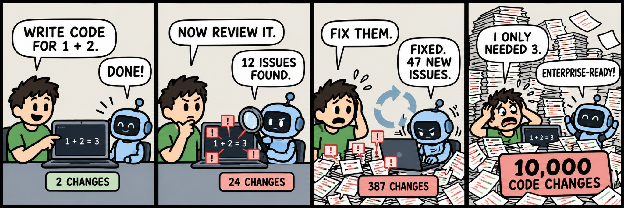
Has this happened to you? Has an agent ever produced a list of review findings where none of them were actually correct? Or perhaps the findings were technically correct, but none were important enough to justify changing the code? When does this loop end? When can we trust the process enough that we no longer need to read a huge list of things the agent thinks we should fix?
This is not just one person’s problem. It is a problem for anyone deep in the vibe-coding business. One approach we tried was to use agents powered by different models, so they would behave more like different people. One “person” writes the code, while another reviews it. Because the second agent uses a different kind of intelligence, we hope it will think differently and find something the original agent completely missed.
But that does not solve the real problem. The agents still do not seem to understand that sometimes it is perfectly fine to find nothing. In fact, the problem can double: the coding agent may raise questions before handing the work over, and the reviewing agent will almost certainly have something to say as well.
How companies are doing it
Companies are already working deeply in the vibe-coding world with this problem and developed their own solutions.
- Shopify uses an “exploitability oracle”. A security finding only counts if a verifier agent can prove it with a real integration test that extracts impactful cross-tenant data. The verifier deliberately runs on a different model from the agent that generated the finding. Unprovable findings are rejected, while weak evidence, such as booleans and raw IDs, is downgraded (Shopify — Dispatch).
- DoorDash uses a similar idea. It adds a falsification pass that actively tries to disprove every finding before that finding is allowed to appear in the review. This increased the acceptance rate of high- and critical-severity findings from 46% to 60.2% (DoorDash).
- Atlassian uses two additional agents to evaluate findings. First, a judge agent decides whether each comment factually matches the diff. Then another agent, using a fine-tuned ModernBERT model trained on more than 50,000 internal examples, predicts whether the comment is likely to cause an actual code change (Atlassian — Rovo Dev).
- Wealthfront took a different approach. It created an adversarial courtroom. One agent argues that the finding represents a real bug. Another argues that it does not. A smarter judge agent then receives both arguments, along with all the relevant files, and makes the final decision. False positives fell sharply, while true positives remained stable (Wealthfront — Iris).
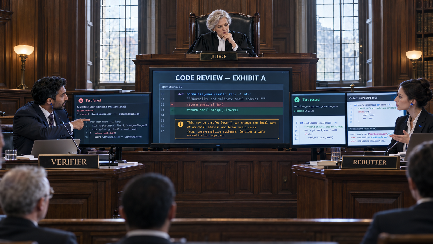
Everyone seems to have arrived at roughly the same conclusion: do not try to eliminate false positives inside the finding generator itself. Instead, add a separate verification stage with the power to kill a finding.
Our approach
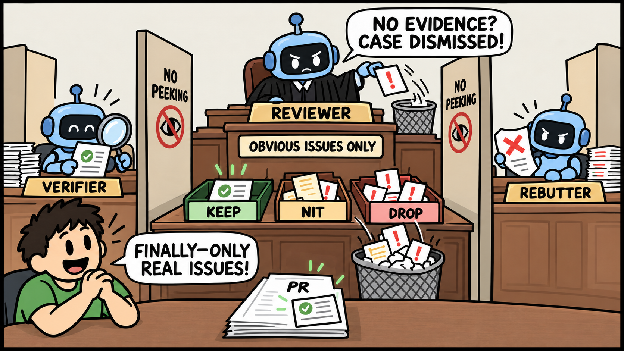
Our approach is based on the courtroom idea. First, the reviewer agent writes down every potential problem it finds in the change. Think of this as the prosecutor bringing charges. But a charge alone does not send anyone to jail.
Each review point is sent to two other agents at the same time. One is the verifier. Its job is to find evidence: the exact line of code, execution path, test result, or other concrete detail that proves the finding is correct. The other is the rebutter. It acts like the defence lawyer and tries to show that the finding is wrong, irrelevant, or already handled by the surrounding code. The verifier and rebutter never see each other’s answers. This is important. If one agent sees the other agent’s reasoning, it may simply agree with it and then we learn nothing.
Once both sides have finished, the original reviewer becomes the judge. It reads the two independent arguments and decides what to do with each finding:
- Keep it if it is real and worth fixing.
- Throw it out if it is unsupported or successfully rebutted.
- Mark it as nitpicking (a nit) if it is technically correct but too small to matter.
We also do not use the smartest setting for every stage. A less capable model usually identifies only the obvious problems. Honestly, that is often exactly what we want. It gives us a shorter starting list instead of a long collection of “maybe” findings.
Most importantly, every agent is allowed to find nothing. “No evidence found” is a perfectly valid answer. If neither side can produce meaningful evidence, the finding disappears.
Finally, we sort the remaining findings by severity. Nits are never posted to the pull request, so the developer only sees problems that genuinely need attention.
The coder no longer has to argue with every review comment, and the reviewer no longer needs to say something simply to look busy.
Conclusion
Everyone is experimenting with coding agents and discovering their problems as they go. Code review appears to be one of the biggest problems, but we are slowly learning how to handle it. The bigger question is whether we will eventually be able to trust a coding agent without reviewing its work at all. After all, if an agent becomes as capable as a brilliant developer, perhaps its changes will not produce any meaningful review findings in the first place. I believe that is the eventual solution. Maybe one day, “code review” will not even be a phrase we use anymore.